
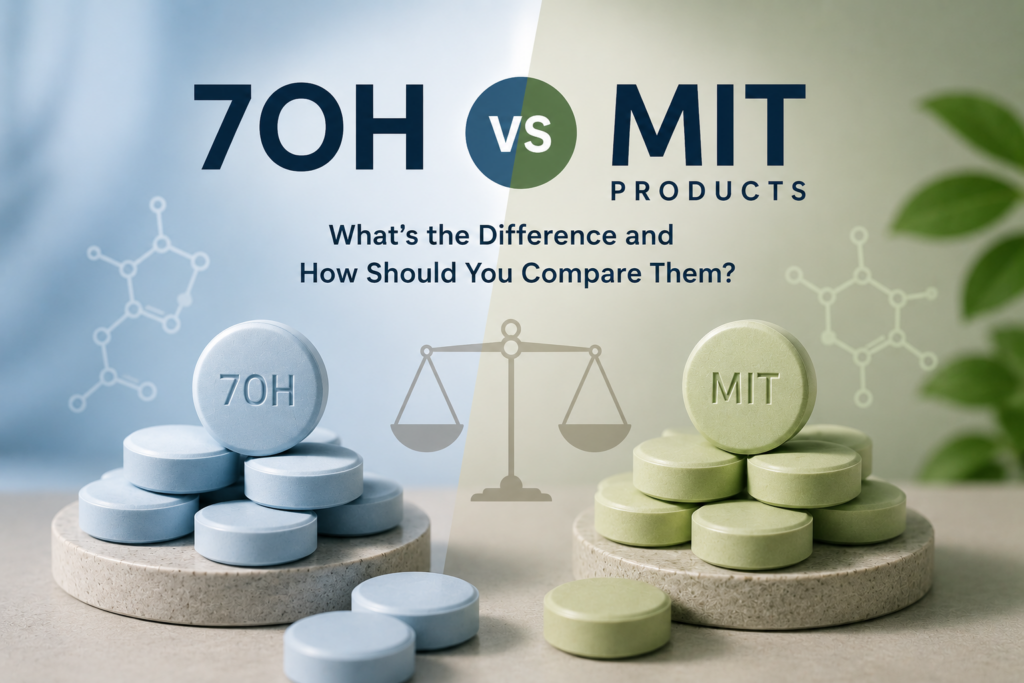
If you are comparing kratom alkaloid products, two terms will come up again and again: 7OH and MIT.
At first, they can sound technical. But once you understand the basics, the difference becomes easier to follow. MIT stands for mitragynine, the main alkaloid found in kratom leaves. 7OH stands for 7-hydroxymitragynine, a related alkaloid found naturally in much smaller amounts but often used in more concentrated modern products.
For shoppers, the real question is not just “Which one is stronger?” It is:
What does the product contain, how much is in each serving, and is the label clear enough to compare responsibly?7OH vs MIT products
This guide breaks down in simple language so you can understand the difference between the two, compare product formats, read labels more carefully, and choose products with better transparency.
Important note: This article is for educational purposes only. Products containing 7-hydroxymitragynine or mitragynine are not FDA-approved to diagnose, treat, cure, or prevent any disease. The FDA recommends consumers avoid 7OH products and states that products containing 7OH have not been proven safe or effective for any use.
Quick Answer: 7OH vs MIT Products
MIT products focus on mitragynine, the primary alkaloid in kratom. These products are often closer to traditional kratom-style formulas, especially when they are MIT-only or MIT-dominant.
7OH products focus on 7-hydroxymitragynine, a more potent minor alkaloid related to kratom. 7OH occurs naturally in small amounts, but many modern 7OH products are concentrated tablets, gummies, shots, capsules, or drink mixes.
|
Product Type |
Simple Meaning |
Common Product Style |
|
MIT Products |
Mitragynine-focused products |
Tablets, shots, powders, capsules, extracts |
|
7OH Products |
7-hydroxymitragynine-focused products |
Tablets, gummies, shots, capsules, drink mixes |
|
7OH + MIT Products |
Products combining both alkaloids |
Dual-alkaloid tablets, capsules, and blends |
The biggest difference is the alkaloid profile. MIT is usually associated with a more traditional kratom alkaloid experience, while 7OH products are often more concentrated and require closer label review.
What are MIT Products?
MIT stands for mitragynine. It is the main naturally occurring alkaloid in kratom leaves and is commonly described as the primary alkaloid responsible for kratom’s traditional alkaloid profile.
7OH.com’s own educational guide explains that mitragynine is the primary alkaloid found in kratom leaves and says it commonly makes up a large share of the plant’s total alkaloid content.
MIT products may include:
- MIT tablets
- MIT shots
- Kratom powders
- Kratom capsules
- Kratom extracts
- MIT-only formulas
- MIT-dominant blends
For example, 7OH.com lists Hydroxie Kratom MIT Tablets, described as a mitragynine-only product with 100mg of mitragynine per chewable tablet and 0% 7OH.
How MIT Products Are Usually Positioned?
MIT products are often positioned around:
- Controlled serving sizes
- Predictable alkaloid labeling
- A mitragynine-focused experience
- Traditional kratom-style product expectations
- Products without added 7OH, depending on the formula
A good MIT product page should clearly tell shoppers:
- How much mitragynine is included
- Whether the product contains 7OH
- Whether it is MIT-only or a blend
- How many servings are in the package
- Whether lab testing is available
- What shipping restrictions apply
What are 7OH Products?
7OH stands for 7-hydroxymitragynine. It is a kratom-related alkaloid found naturally in small amounts in Mitragyna speciosa, and CFSRE also describes it as an active metabolite of mitragynine.
The key point is that many modern 7OH products are not the same as basic kratom leaf products. They are often concentrated or enhanced products, such as:
- 7OH tablets
- 7OH gummies
- 7OH capsules
- 7OH drink shots
- 7OH drink mixes
- 7OH extract-style products
The FDA has raised concern around concentrated 7OH products such as tablets, gummies, drink mixes, and shots, stating that 7OH is not approved for medical use and is not lawful as a dietary supplement or when added to conventional foods.
How 7OH Products Are Usually Positioned?
7OH products are often marketed as:
- Higher-potency
- Concentrated
- Fast-use format
- Easy to carry
- Precision-dosed
- Tablet-, capsule-, gummy-, or shot-based
For example, 7OH.com lists 7OH.com Premium Kratom Alkaloid Tablets, described as chewable tablets containing 80mg of 7-hydroxymitragynine per tablet with lab report dates shown on the product page.
Why 7OH Labels Need Extra Attention?
Because 7OH products are often more concentrated, shoppers should review the label carefully.
Check:
7OH vs MIT Products: Side-by-Side Comparison
|
Factor |
MIT Products |
7OH Products |
|
Full Name |
Mitragynine |
7-Hydroxymitragynine |
|
Relationship to Kratom |
Primary kratom alkaloid |
Minor kratom alkaloid and mitragynine metabolite |
|
Common Formats |
Tablets, shots, powders, capsules, extracts |
Tablets, gummies, capsules, shots, drink mixes |
|
Product Positioning |
More traditional or MIT-focused |
More concentrated and specialized |
|
Label Priority |
MIT mg per serving |
7OH mg per serving |
|
Common Buyer Concern |
Is it MIT-only or blended? |
How concentrated is the 7OH? |
|
Regulatory Attention |
Kratom products remain under FDA concern |
FDA has specifically warned about 7OH products |
|
Best For Comparison |
Alkaloid profile and MIT content |
Potency, serving size, and transparency |
Are 7OH and MIT the Same Thing?
No. 7OH and MIT are related, but they are not the same compound.
MIT is mitragynine, the primary alkaloid in kratom. 7OH is 7-hydroxymitragynine, a related alkaloid that appears naturally in smaller amounts and may also form when the body processes mitragynine. CFSRE describes 7OH as both a small-amount kratom alkaloid and an active metabolite of mitragynine.
A simple way to understand it:
- MIT = the main kratom alkaloid
- 7OH = a smaller but more potent related alkaloid
- 7OH + MIT = a blended formula containing both
This matters because two products may look similar but have very different formulas.
Which Is Stronger: 7OH or MIT?
In many scientific and product discussions, 7OH is described as more potent than MIT, especially in relation to opioid receptor activity. CFSRE reports that 7-hydroxy mitragynine is approximately 10 times more potent than mitragynine in cited pharmacology data.
7OH.com’s educational guide also states that 7OH may be around 10–17 times more potent than MIT at opioid receptors, while emphasizing that dosing precision matters more with 7OH because of its increased strength.
But for shoppers, “stronger” is not enough information.
A real product comparison should ask:
- How many milligrams are in each serving?
- Is the product MIT-only, 7OH-only, or a blend?
- How many servings are in the package?
- Is the product designed for experienced users?
- Does the label include clear usage guidance?
- Is lab testing available?
A low-dose 7OH product and a high-dose MIT product are not automatically comparable. Always compare the actual label, not just the alkaloid name.
Where Do 7OH + MIT Products Fit?
Some products combine both 7OH and MIT into one formula.
For example, 7OH.com lists Blendz 7-OH Super Alkaloid Capsules, described as containing 10mg of 7OH and 50mg of mitragynine per capsule.
7OH.com also lists Kream 7-OH + Pseudo + MIT Tablets, where each chewable tablet contains 25mg of 7OH, 5mg of Pseudoindoxyl, and 70mg of Mitragynine.
Why Blended Products Need Careful Review
Blended products can be useful for shoppers who want more than one alkaloid in a single formula, but they also require closer label reading.
Before buying a 7OH + MIT product, check:
Product Format: Tablets, Shots, Capsules, Powders, and Gummies
The difference between 7OH and MIT is not only about chemistry. It is also about product format.
MIT Tablets
MIT tablets are designed for shoppers who want a more controlled mitragynine-focused product. Compared with loose powder, tablets can make the serving size easier to understand.
Example: Hydroxie Kratom MIT Tablets on 7OH.com are listed as 100mg mitragynine per tablet with a 0% 7OH profile.
MIT Shots
MIT shots are liquid products that focus on mitragynine content. They are usually positioned as convenient and ready to use.
Example: Hydroxie Kratom MIT Shot is listed as containing 400mg mitragynine with 0% 7OH.
7OH Tablets
7OH tablets are usually more concentrated and should be checked carefully for milligrams per tablet.
Example: 7OH.com Premium Kratom Alkaloid Tablets are listed as 80mg 7-hydroxymitragynine per tablet.
7OH + MIT Capsules
Capsules may combine 7OH and MIT in one portable formula.
Example: Blendz 7-OH Super Alkaloid Capsules are listed as containing 10mg 7OH and 50mg mitragynine per capsule.
Gummies, Drink Mixes, and Other Formats
The FDA has specifically mentioned gummies, drink mixes, tablets, and shots in its warnings around concentrated 7OH products. That does not mean every format is the same, but it does mean shoppers should read labels and disclaimers carefully.
How to Compare 7OH vs MIT Products Before Buying?
A smart comparison should go beyond the headline claim or product name.
1. Start With the Alkaloid Profile
Check whether the product is:
- MIT-only
- 7OH-only
- 7OH + MIT
- 7OH + Pseudo + MIT
- A broader kratom extract blend
This tells you what kind of product you are actually comparing.
2. Compare Milligrams Per Serving
Do not compare products only by total package strength.
Ask:
- How many mg are in one serving?
- Is one tablet one serving?
- Is the serving a half tablet?
- Is the bottle divided into multiple servings?
- Is the strength listed as total alkaloids or individual alkaloids?
For example, a 400mg MIT shot and an 80mg 7OH tablet are not “equal” just because both show large numbers. They contain different alkaloids with different potency profiles.
3. Check Whether 7OH Is Present
Some shoppers specifically want MIT-focused products without added 7OH.
In that case, look for language such as:
- “MIT-only”
- “0% 7OH”
- “Mitragynine-only”
- “No 7-hydroxymitragynine”
7OH.com’s Hydroxie MIT listings use this kind of positioning, describing MIT tablets and MIT shots as products with 0% 7OH.
4. Look for Lab Reports or COAs
Lab testing matters in this category because shoppers need to know what is actually in the product.
Look for testing that verifies:
- Mitragynine content
- 7OH content
- Heavy metals
- Microbial safety
- Pesticides
- Batch or lot details
7OH.com’s educational article on spotting low-quality MIT tablets highlights Certificates of Analysis as an important legitimacy signal for mitragynine content, 7OH levels, heavy metals, microbial safety, and pesticide screening.
5. Compare Cost Per Serving, Not Just Price
A product may cost more but include more servings or a higher total alkaloid amount.
Compare:
- Price per pack
- Number of tablets, capsules, or servings
- Cost per serving
- Cost per mg
- Whether the product is single-alkaloid or blended
Some 7OH.com product listings display price-per-tab and price-per-mg information, which can help shoppers compare value more clearly.
6. Review Shipping Restrictions
Kratom-related and concentrated alkaloid products may be restricted depending on location.
Before ordering, check:
- State restrictions
- County restrictions
- Local laws
- Product-specific shipping limitations
This is especially important because availability can change over time.
7. Avoid Medical Claims
Be careful with products that claim to treat:
- Pain
- Anxiety
- Depression
- Opioid withdrawal
- Insomnia
- Any disease or medical condition
The FDA states that there are no FDA-approved products containing 7OH and warns consumers to avoid 7OH products, including those claiming to treat ailments or disorders.
Which Product Type Is Better for Beginners?
For beginners, MIT-focused products are often easier to understand because they are closer to the traditional kratom alkaloid conversation and may be less concentrated than 7OH-focused products.
That said, beginners should still be cautious with any kratom alkaloid product.
A beginner-friendly comparison approach would be:
7OH.com’s own MIT vs 7OH guide suggests that beginners generally start with MIT-dominant kratom products, while experienced users may explore 7OH products only after understanding tolerance and responsible dosing practices.
Common Mistakes Shoppers Make
Mistake 1: Assuming 7OH and MIT Are Interchangeable
They are related, but they are not the same. MIT and 7OH differ in potency, concentration, and product positioning.
Mistake 2: Looking Only at Total Milligrams
A bottle may contain 400mg total, while a tablet pack may contain 500mg total. But what matters most is mg per serving and which alkaloid is being measured.
Mistake 3: Ignoring 0% 7OH Claims
If you want a mitragynine-only product, look for clear 0% 7OH labeling. This helps separate MIT-only products from 7OH + MIT blends.
Mistake 4: Assuming “Stronger” Means “Better”
Higher potency is not automatically better. Clarity, serving control, lab testing, and responsible use are more important than hype.
Mistake 5: Skipping the Disclaimer
FDA and safety disclaimers are important in this category. They help explain that these products are not approved to treat, cure, or prevent disease.
Final Takeaway: Compare the Alkaloid, Serving Size, and Label
When comparing 7OH vs MIT products, the most important thing is to understand what is actually inside the product.
MIT products focus on mitragynine, the primary alkaloid in kratom. They are often positioned as more traditional or mitragynine-focused products. 7OH products focus on 7-hydroxymitragynine, a more potent related alkaloid that is often sold in concentrated formats and has received specific FDA warnings.
Before buying, compare:
- Alkaloid type
- Milligrams per serving
- Total package strength
- Product format
- Lab testing information
- Shipping restrictions
- Disclaimer language
- Whether the product is MIT-only, 7OH-only, or blended
For shoppers who want to compare clearly labeled tablets, shots, capsules, and alkaloid blends, 7OH.com’s product pages can help make potency, format, and formula differences easier to review before choosing.
FAQs About 7OH vs MIT Products
Q. What does MIT mean?
MIT means mitragynine, the primary alkaloid found in kratom leaves. MIT products are usually mitragynine-focused and may come in tablets, shots, powders, capsules, or extracts.
Q. What does 7OH mean?
7OH means 7-hydroxymitragynine, a kratom-related alkaloid found naturally in small amounts and also described as an active metabolite of mitragynine.
Q. Are 7OH and MIT the same?
No. MIT is mitragynine, while 7OH is 7-hydroxymitragynine. They are related but different compounds.
Q. Is 7OH stronger than MIT?
7OH is commonly described as more potent than MIT in opioid receptor activity. CFSRE reports that 7-hydroxy mitragynine is approximately 10 times more potent than mitragynine in cited pharmacology data.
Q. Are MIT products available without 7OH?
Yes. Some products are positioned as MIT-only or 0% 7OH. For example, 7OH.com lists Hydroxie Kratom MIT Tablets as containing 100mg mitragynine per tablet with 0% 7OH.
Q. Are 7OH + MIT products available?
Yes. Some products combine both alkaloids. For example, Blendz 7-OH Super Alkaloid Capsules are listed with 10mg 7OH and 50mg mitragynine per capsule.
Q. Are 7OH products FDA-approved?
No. The FDA states that there are no FDA-approved products containing 7OH and recommends that consumers avoid 7OH products.
Q. What should I check before buying 7OH or MIT products?
Check the alkaloid type, milligrams per serving, total package strength, product format, lab testing information, serving instructions, shipping restrictions, and FDA disclaimer.
Q. Which is better: 7OH or MIT?
Neither is automatically “better.” MIT products may appeal to shoppers looking for a mitragynine-focused formula, while 7OH products are more concentrated and require more careful label review. The better choice depends on the product formula, transparency, legality, and the shopper’s experience level.